Full-Duplex Underwater Acoustic Communications
Spatial self-interference cancellation and Doppler compensation for simultaneous underwater acoustic transmission and reception.
Overview
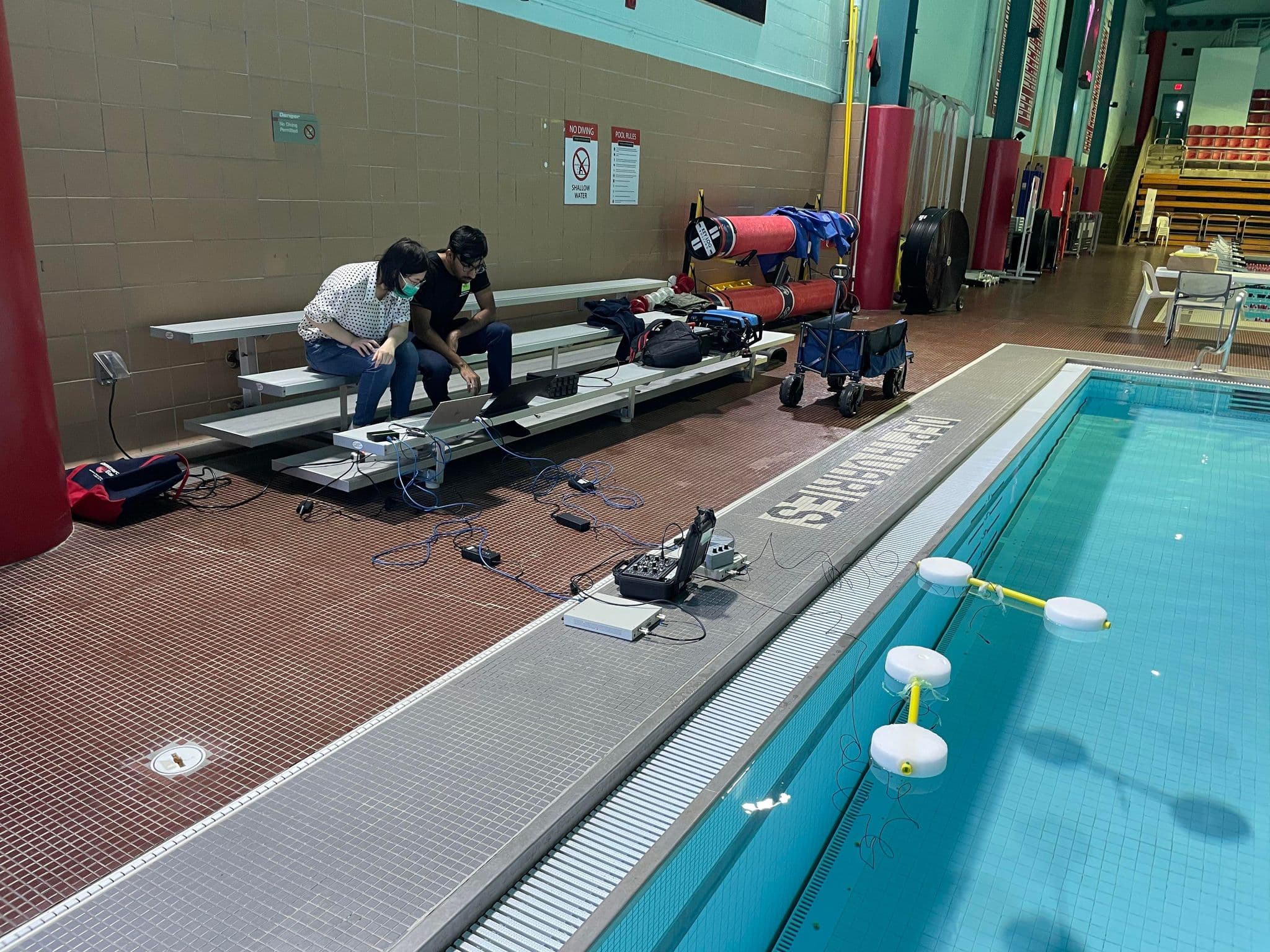
Full-duplex underwater acoustic links must recover incoming signals while suppressing interference from their own transmitter. This research addresses that constraint through spatial self-interference cancellation, supported by work on joint Doppler estimation and compensation. The objective is to improve acoustic-channel utilization while accounting for the propagation and motion effects that complicate underwater communications. The project connects signal-processing methods with experimental acoustic-link evaluation.
Engineering Relevance
Addresses interference and channel variation that limit simultaneous transmission and reception in underwater acoustic networks.
Methods & Tools
Selected Results
Spatial self-interference cancellation for full-duplex acoustic communication
Joint Doppler estimation and compensation using machine-learning methods
Experimental validation in underwater acoustic channels
Related work published in Journal of Communications and Networks, IEEE MASS, and ACM WUWNet
Publications
FD-UWA: Full-duplex underwater acoustic comms via self-interference cancellation in space
2020 IEEE 17th International Conference on Mobile Ad Hoc and Sensor Systems (MASS)
2020
Cited by 19
Full-Duplex Underwater Acoustic Communications via Self-Interference Cancellation in Space
Journal of Communications and Networks 25(2), 167-181
2023
Cited by 26
ML-based joint Doppler estimation and compensation in underwater acoustic communications
Proceedings of the 16th International Conference on Underwater Networks and Systems (WUWNet)
2022
Cited by 21
Demo: ML-based Joint Doppler Estimation and Compensation in Underwater Acoustic Comms
ACM WUWNet Demo
2022
Cited by 0
Related Projects
AI-Assisted S-Parameter Prediction
Neural modeling and signal preprocessing to accelerate Channel Operating Margin prediction for high-speed interconnect evaluation.
Learn more →
Ultra-Low-Power Analog Neural Networks for ECG Monitoring
Analog neural-network architectures that reuse computation hardware to reduce power and area requirements for ECG monitoring.
Learn more →
Discuss the Engineering
Get in touch to discuss signal integrity modeling, low-power inference, or related research and engineering work.