AI-Assisted S-Parameter Prediction
Neural modeling and signal preprocessing to accelerate Channel Operating Margin prediction for high-speed interconnect evaluation.
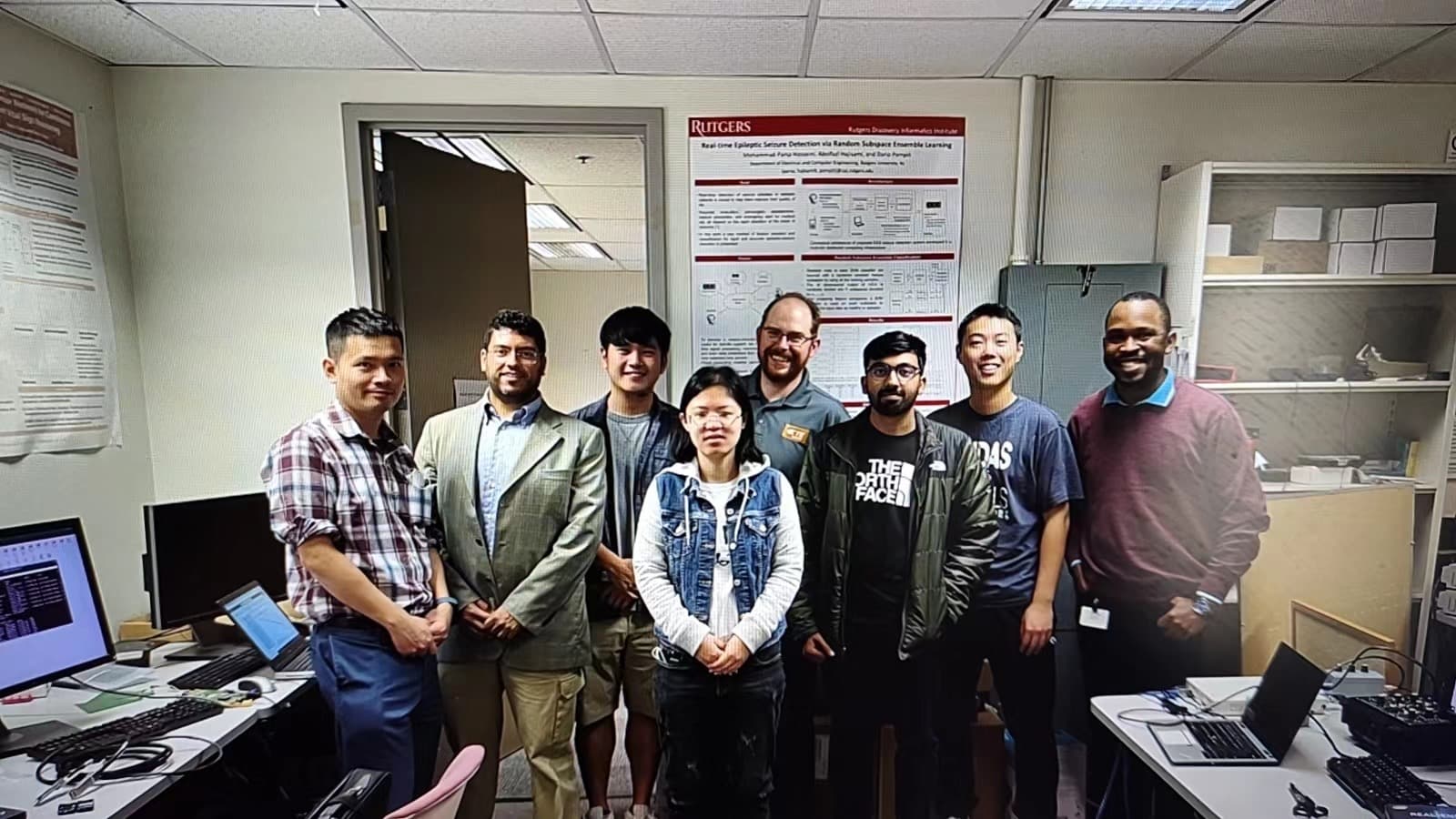
Overview
High-speed interconnect evaluation depends on repeated signal analysis, which can make design exploration computationally expensive. For the TE AI Cup 2022-23, our Rutgers team developed neural-network architectures and signal preprocessing methods to predict IEEE-standard Channel Operating Margin (COM) parameters in place of a time-consuming model-based MATLAB workflow. The project received the Best AI Innovation prize. Rutgers estimated $12.5M in potential savings in tester time and capital expenditure for high-speed testing.
Engineering Relevance
Demonstrates how learned models can accelerate a defined SI evaluation workflow, with potential reductions in high-speed testing time and equipment cost.
Methods & Tools
Selected Results
Best AI Innovation prize, TE AI Cup 2022-23
Neural-network architectures and signal preprocessing for COM parameter prediction
Project benchmarks reported up to 4,000× faster prediction and approximately 4% prediction error; results are specific to the evaluated workflow
Estimated $12.5M in potential tester-time and capital-expenditure savings, as reported by Rutgers
Recognized in a competition involving 40 teams from 25 universities
References
Rutgers ECE Team Won Best AI Innovation Prize in TE AI Cup 2022-23
Rutgers University ECE Newsletter 2023
2024
Related Projects
Ultra-Low-Power Analog Neural Networks for ECG Monitoring
Analog neural-network architectures that reuse computation hardware to reduce power and area requirements for ECG monitoring.
Learn more →
Spiking Neural Networks for Signal Processing
Hybrid analog-digital and event-driven neural architectures for power-constrained sensing and temporal signal processing.
Learn more →
Discuss the Engineering
Get in touch to discuss signal integrity modeling, low-power inference, or related research and engineering work.